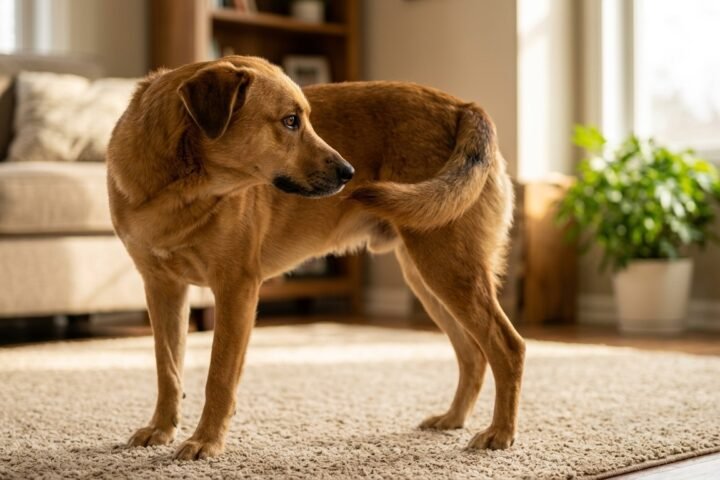
If you have ever watched your dog walk in a small circle, turn around again, paw at the bed, and finally curl up, you may have wondered, why do dogs circle before lying down? This familiar bedtime ritual is usually normal, but it can have several possible explanations.
Dogs may circle before lying down to make their resting area more comfortable, follow an inherited behavioral pattern, adjust their body position, or simply settle into a familiar routine. Some dogs also scratch, dig, or rearrange blankets as part of the same pre-sleep ritual.
However, there is an important distinction between a few purposeful turns and repeated or difficult circling. If your dog suddenly starts circling excessively, cannot settle, seems painful, or shows other unusual symptoms, the behavior may deserve veterinary attention. VCA Animal Hospitals notes that excessive circling can occur when dogs are struggling to find a comfortable position because of orthopedic or spinal problems.
So, why do dogs circle before lying down? Here are six possible reasons—and how to recognize when the behavior may be more than an adorable bedtime habit.
Table of Contents
1. Dogs May Circle to Make Their Sleeping Spot Comfortable
One of the simplest explanations for why dogs circle before lying down is comfort.
Before domestication, wild canines did not have orthopedic mattresses, blankets, or plush dog beds. Their resting places could contain grass, leaves, sticks, stones, snow, or uneven ground. Moving around the area could help flatten vegetation and create a more suitable place to rest.
Modern dogs obviously have much easier sleeping arrangements, but instinctive behaviors can remain even when the original purpose is no longer necessary.

Your dog may therefore circle around a bed—even a perfectly soft one—as though they are preparing it for the night.
This behavior often appears alongside:
- Scratching at blankets
- Pawing at bedding
- Nudging a pillow
- Digging at a dog bed
- Turning several times
- Curling into a preferred sleeping position
Research and behavioral observations suggest that the comfort explanation deserves attention. Dogs have been observed to circle more frequently when presented with uneven or soft surfaces than when resting on smoother, flatter surfaces.
That does not mean every dog consciously thinks, “I need to flatten this bed.” Instead, circling may be part of an instinctive sequence associated with preparing to rest.
What this looks like in a healthy dog
Normal circling is usually:
- Brief
- Purposeful
- Followed by lying down
- Similar from day to day
- Not accompanied by obvious distress
If your dog makes two or three turns and then happily settles into bed, there is usually little reason for concern.
2. It May Be an Inherited Canine Behavior
Another answer to why do dogs circle before lying down involves their evolutionary history.
Wild canines display similar pre-rest behaviors, and many veterinary and canine behavior resources describe modern circling as an inherited behavior that may have developed before dogs lived alongside humans.
Imagine a wild canine preparing to sleep outdoors. There is no guarantee that the selected location is flat, clean, or comfortable. Walking around the area could help prepare the surface while also becoming part of a predictable settling routine.
Over generations, behavioral patterns that once served practical purposes can remain even after the environment changes.
That is why your dog may still perform a little bedtime dance on a soft mattress in your living room.
However, it is important not to treat every evolutionary explanation as proven fact. Scientists still do not have one definitive answer for why all dogs circle before lying down. Several explanations are plausible, and individual dogs may circle for different reasons.
An important distinction
You may hear that circling is definitely something dogs inherited from wolves to protect themselves from predators.
That is better described as a theory, not an established fact.
The behavior is clearly common and can resemble behaviors seen in wild canids, but determining exactly why the behavior originally evolved is more difficult.
For dog owners, the most useful takeaway is simple: a short, consistent circling routine before sleep is generally compatible with normal canine behavior.
3. Circling May Help a Dog Check Its Surroundings
Another proposed explanation is that circling gave wild dogs an opportunity to inspect their surroundings before settling down.
A wild animal resting outdoors was more vulnerable than a dog sleeping safely inside a home. Moving around the chosen resting area could potentially help the animal inspect the immediate environment before lying down.
VCA describes several possible ancestral functions, including surveying the surrounding area and detecting potential threats.
There is also a theory that circling may have helped wild canines orient themselves according to wind direction so they could detect unfamiliar scents.
These explanations are fascinating, but again, they should be treated as behavioral theories rather than guaranteed reasons behind every modern dog’s bedtime routine.
Your Labrador circling the same fluffy bed every night is not necessarily checking for an imaginary predator behind the couch.
Instead, the behavior may simply be an inherited pattern that persists because it feels natural and helps the dog transition into rest.
Why dogs may still perform the ritual indoors
Dogs do not need to consciously understand the original purpose of a behavior for that behavior to remain.
Just as dogs may sniff extensively during walks even when they are not hunting, they can perform inherited behavioral sequences in completely modern environments.
A few circles before sleep can therefore be normal even when there is absolutely nothing dangerous to inspect.
4. Your Dog May Be Adjusting Its Body Position
Sometimes the answer to why do dogs circle before lying down is much less complicated: your dog is simply trying to find the right position.
Dogs have individual sleeping preferences.
One dog may immediately flop onto its side. Another may curl tightly into a ball. A third may stretch across the entire bed before eventually turning around.
Circling gives your dog a chance to adjust its body position before settling.
You may notice your dog:
- Walk toward the bed.
- Turn around.
- Pause.
- Turn again.
- Sniff the surface.
- Scratch or paw at the bedding.
- Lower its body.
- Shift once more.
- Finally settle down.
This can be completely ordinary.
Dogs also change sleeping positions throughout the day depending on temperature, surface, surroundings, and personal preference.
For example, a dog may curl tightly when cold and stretch out when warm. A dog may choose a cooler floor during hot weather and a soft bed during colder weather.
The circling itself may therefore be part of the process of finding the position that feels right.
5. Circling Can Be Part of a Nesting or Bedtime Routine
Dogs often have routines surrounding sleep.
Your dog may:
- Carry a toy to the bed
- Scratch the blanket
- Sniff the bedding
- Circle
- Turn around
- Sigh
- Curl up
- Fall asleep
This sequence can become a predictable bedtime ritual.
Some dogs even appear to “arrange” their sleeping area despite having no practical reason to do so. A blanket that is already perfectly positioned may still need to be pushed around before the dog considers the job complete.
This resembles nesting behavior.
VCA explains that wild canines could have used related behaviors to prepare resting areas by moving vegetation, debris, or other uncomfortable objects.

Modern dogs can express the same general behavioral pattern through scratching and rearranging blankets.
Should you stop your dog from circling?
Usually, no.
If your dog circles briefly and then settles comfortably, there is generally no need to interrupt the behavior.
In fact, repeatedly stopping harmless bedtime rituals may create unnecessary frustration.
Instead, make sure your dog has a comfortable, appropriately sized sleeping area and observe the behavior over time.
The important question is not simply “Does my dog circle?”
The better question is:
“Does my dog circle normally and then settle, or does my dog struggle to settle?”
That distinction becomes especially important as dogs age or if their behavior suddenly changes.
6. Excessive Circling Can Sometimes Mean Something Is Wrong
This is the most important reason to pay attention to changes in your dog’s circling behavior.
Normal pre-sleep circling is generally brief and ends with comfortable relaxation.
Excessive circling is different.
A dog that repeatedly circles, gets up, lies down, gets up again, circles again, or seems unable to find a comfortable position may be experiencing discomfort.
VCA specifically notes that dogs in pain may circle excessively because they are trying to find a position that feels comfortable. Arthritis, back problems, and spinal disorders can make lying down or getting back up difficult.
Recent veterinary guidance also emphasizes the difference between a few circles before lying down and persistent circling that occurs repeatedly or independently of bedtime. Repetitive circling can sometimes be associated with pain, vestibular problems, neurological disease, or cognitive dysfunction, particularly in older dogs.

Signs that circling may be concerning
Pay closer attention if your dog:
- Suddenly starts circling much more than usual
- Takes a long time to settle
- Repeatedly gets up and lies back down
- Whines while trying to lie down
- Appears stiff
- Hesitates before jumping or climbing stairs
- Has difficulty getting up
- Favors a leg
- Seems restless at night
- Circles repeatedly in one direction
- Appears confused
- Has a head tilt
- Stumbles or loses balance
- Shows unusual eye movements
- Develops other sudden behavioral changes
One isolated episode does not automatically mean something is seriously wrong.
But a new, persistent, or worsening pattern deserves attention.
When Should You Worry About Your Dog Circling?
A useful way to distinguish normal from potentially concerning behavior is to look at the entire pattern.
| Normal pre-sleep circling | Potentially concerning circling |
|---|---|
| Happens before lying down | Happens repeatedly throughout the day |
| Lasts a short time | Continues for a long time |
| Dog eventually settles | Dog cannot settle |
| Looks relaxed | Dog looks anxious or uncomfortable |
| Same routine as usual | Sudden change from normal behavior |
| No other symptoms | Pain, stiffness, weakness, confusion, or balance problems |
| Dog sleeps normally afterward | Sleep is repeatedly interrupted |
If your dog has suddenly developed persistent circling or is struggling to get comfortable, contact your veterinarian rather than assuming it is simply an old canine instinct.
What about an older dog?
Age deserves special attention.
Older dogs can develop arthritis and other conditions that make getting into a comfortable sleeping position more difficult. Persistent circling can also occur alongside neurological or cognitive problems.
That does not mean every older dog who circles before bed has a medical condition.
A senior dog who has always made two or three circles before sleeping and continues to do so comfortably may simply be following its normal routine.
The concern is a change in pattern.
If your senior dog suddenly starts circling much longer than usual, repeatedly gets up, seems confused, or struggles to lie down, a veterinary evaluation is appropriate.
Is It Normal for Dogs to Circle Several Times Before Lying Down?
Yes, it can be.
There is no universal number of circles that every dog should make.
Some dogs may turn once. Others may turn several times. Some may scratch their bedding between turns, while others simply walk in a small circle and lie down.
The number itself is less important than the dog’s overall behavior.
For example, a dog that makes six quick circles and immediately falls asleep may be perfectly comfortable.
A dog that makes three circles but repeatedly stands up, pants, whines, and cannot settle may have a more important problem.
Behavioral context matters more than counting circles.
Why Does My Dog Circle and Scratch Before Lying Down?
Circling and scratching often occur together because both behaviors can be associated with preparing a resting area.
A dog may scratch a blanket, turn around, push the bedding with its nose, and then circle again before lying down.
This may be especially noticeable in dogs that enjoy nesting.
The behavior can look dramatic when your dog attacks a perfectly innocent blanket for 30 seconds before curling up peacefully.
As long as the dog is comfortable and the routine has not suddenly changed, this is generally not something you need to stop.
If the scratching becomes frantic, repetitive, destructive, or appears connected to discomfort, however, look at the bigger behavioral picture.
Why Does My Dog Circle More on Some Beds Than Others?
The sleeping surface may make a difference.
A soft, uneven, unstable, or unfamiliar surface may encourage more repositioning than a firm, flat surface.
Dogs can also have individual preferences for temperature and texture.
You may notice your dog circle more on:
- Thick blankets
- Loose bedding
- Sofas
- New dog beds
- Uneven cushions
- Grass
- Carpet
And circle less on:
- Firm mattresses
- Smooth floors
- Familiar sleeping surfaces
This fits with observations that dogs can show more circling behavior when dealing with surfaces that require more adjustment.
If your dog circles excessively on a particular bed but settles easily elsewhere, the sleeping surface itself may be worth considering.
How to Make Your Dog More Comfortable at Bedtime
If your dog’s circling is normal but you want to encourage easier settling, start with the basics.
Choose the right bed
Your dog’s bed should be large enough for the dog to turn around and stretch or curl up comfortably.
For older dogs or dogs with mobility concerns, supportive bedding may be particularly useful.
Keep the sleeping area quiet
A predictable, low-stress sleeping environment can make it easier for your dog to settle.
Keep the bedding clean
Dogs rely heavily on scent, but dirty or heavily soiled bedding can become unpleasant and may discourage comfortable resting.
Watch the temperature
Dogs may change their sleeping behavior depending on whether they are too warm or cold.
Provide a comfortable resting area away from extreme temperatures.
Don’t punish normal circling
If your dog makes a few circles before lying down, there is usually no reason to correct the behavior.
It is part of the dog’s normal way of settling.
When Circling Is More Than a Bedtime Habit
It is important not to confuse pre-sleep circling with persistent walking in circles.
These are not necessarily the same behavior.
A dog that circles twice before lying down is displaying a familiar settling ritual.
A dog that repeatedly walks in circles around the house, particularly if it always turns in one direction or shows other neurological signs, may have a completely different issue.

Veterinary neurologists and other veterinary specialists note that persistent circling can be associated with problems involving balance, the inner ear, pain, neurological function, or cognitive decline.
Seek veterinary advice promptly if circling is accompanied by signs such as:
- Head tilt
- Loss of balance
- Falling
- Vomiting
- Weakness
- Abnormal eye movements
- Collapse
- Severe confusion
- Sudden inability to walk normally
These symptoms are different from an ordinary bedtime routine and should not simply be attributed to instinct.
FAQ
Why do dogs circle before lying down?
Dogs may circle before lying down as part of an inherited resting behavior, to adjust their sleeping position, prepare the surface, or settle into a familiar bedtime routine. Scientists do not have one definitive explanation for every dog’s circling behavior.
How many times should a dog circle before lying down?
There is no specific normal number. Some dogs turn once, while others turn several times. The more important factor is whether your dog quickly settles afterward and appears comfortable.
Should I stop my dog from circling before bed?
Usually not. Brief circling followed by comfortable settling is generally harmless. You should pay more attention if the circling becomes excessive, painful, difficult to interrupt, or noticeably different from your dog’s normal routine.
Why is my dog suddenly circling a lot before lying down?
A sudden increase in circling can sometimes indicate difficulty getting comfortable. Pain from arthritis, orthopedic problems, or back and spinal issues may cause a dog to repeatedly reposition itself. If the change persists or occurs with other symptoms, speak with your veterinarian.
Conclusion
So, why do dogs circle before lying down?
For most dogs, it is a normal part of settling down. Circling may help a dog adjust its sleeping position, prepare its resting area, follow an inherited behavioral pattern, or simply transition from activity to rest.
The traditional explanation that dogs circle because their wild ancestors needed to flatten grass, check their surroundings, or prepare a safe sleeping spot is plausible and supported by observations of wild canids. However, researchers still cannot say with certainty that one explanation accounts for every dog’s behavior.
What matters most for today’s dog owner is the pattern.
A few quick circles followed by peaceful sleep are usually nothing to worry about.
Repeated circling, difficulty settling, pain, stiffness, confusion, balance problems, or a sudden behavioral change are different. Those signs can justify a conversation with your veterinarian.
In other words, your dog’s little bedtime dance is usually just that—a bedtime ritual. But if the dance suddenly becomes longer, more frantic, or uncomfortable, it is worth paying attention.